

“Criminal justice in America sometimes seems more criminal than just — replete with error, malfeasance, racism and cruel, if not unusual, punishment, coupled with stubborn resistance to reform and a failure to learn from even its most glaring mistakes.” – Bryan Stevenson in Just Mercy.
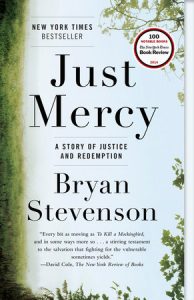
On May 18, I gathered with a group of WWF members and their guests at the Seattle Public Library to discuss this year’s Member Engagement Committee book selection, Just Mercy(opens in new tab) by Bryan Stevenson. Much of our discussion focused on the discriminatory impact of systems, and specifically the criminal justice system, on low-income people of color.
Here’s a little background for those who haven’t read the book: Mr. Stevenson is the founder and Executive Director of the Equal Justice Initiative(opens in new tab) (EJI) in Montgomery, Alabama. Just Mercy weaves together the stories of the poor, incarcerated and condemned men, women and children helped by Mr. Stevenson and EJI.
EJI “is committed to challenging racially discriminatory policies, sentencing, and tactics that have made mass imprisonment a crisis in many communities of color.” The organization has won major legal challenges eliminating excessive and unfair sentencing, exonerating innocent prisoners on death row, confronting abuse of the incarcerated and the mentally ill and helping children who have been prosecuted as adults.
At the discussion, I highlighted the following quote from Just Mercy:
Proximity has taught me some basic and humbling truths, including this vital lesson: Each of us is more than the worst thing we’ve ever done…. I’ve come to believe that the true measure of our commitment to the rule of law, fairness, and equality cannot be measured by how we treat the rich, the powerful, the privileged, and the respected among us. The true measure of our character is how we treat the poor, the disfavored, the accused, the incarcerated, and the condemned.
I am taking to heart this quote and the advice that Mr. Stevenson’s grandmother gave him, “You can’t understand most of the important things from a distance, Bryan. You have to get close.” At Washington Women’s Foundation, we are committed to “getting close” through visiting not-for-profits, building authentic and honest relationships with our grantees and highlighting underrepresented voices.
I hope that we can challenge ourselves to get closer.
If you weren’t able to attend the discussion this week, we hope you will still add to the conversation and bring your reflections to the next WWF event you attend. (If you don’t have an opportunity to read the book, we highly recommend listening to Mr. Stevenson’s TEDTalk(opens in new tab).)
Here are some questions to ponder:
- We each read this book or heard Mr. Stevenson’s stories with different knowledge and experiences. Acknowledging that, what surprised, troubled or challenged you as you read this book or listened to Mr. Stevenson’s talk?
- Did Mr. Stevenson’s examples resonate with you or were you shocked? Is his message an eye-opener for you or a validation of what you already knew? Consider how your reaction would differ if you were of a different race or class, if you were the victim of a serious crime, or if you or a family member had personal experience with the justice system.
- Stevenson says that his “work with the poor and incarcerated has persuaded me that the opposite of poverty is not wealth; the opposite of poverty is justice.” What does this statement mean to you? What is “justice?”
- The New York Times says Just Mercy reads like a call to action. Are you compelled to take action after reading this book? Or have you already changed your actions since reading Just Mercy? What action are you called to?
Additional Resources
Related books recommended by fellow members:
Alexander, Michelle. Jim Crow: Mass Incarceration in the Age of Colorblindness(opens in new tab)
Coates, Ta-Nahisi. Between the World and Me(opens in new tab)
Irving, Debby. Waking Up White, and Finding Myself in the Story of Race(opens in new tab)
Taibbi, Matt. The Divide: American Injustice in the Age of the Wealth Gap(opens in new tab)
Articles recommended:
Coates, Ta-Nahisi. The Case for Reparations(opens in new tab)
Coates, Ta-Nahisi. The Black Family in the Age of Mass Incarceration(opens in new tab)
DiAngelo, Robin. America’s White Fragility Complex: Why White People get Defensive About Their Privilege(opens in new tab)
Other Articles on Race & Justice, Children in Prison, Mass Incarceration, and the Death Penalty: https://www.eji.org/news(opens in new tab)
Trainings recommended:
Undoing Institutionalized Racism(opens in new tab), led by the People’s Institute Northwest
Exploring Race and Class Intersections(opens in new tab), led by Class Action (Beth & Emily are attending upcoming training on June 17, 2016)
Internalized Sexism and White Privilege: A Workshop for White Women
(opens in new tab)Thursday & Friday, July 7th & 8th, 2016 from 9 a.m. – 4:30 p.m., 2100 Building
Through our groundbreaking model of women-powered, collective philanthropy, Washington Women’s Foundation has given out $15 million in transformative grants that enable not-for-profit organizations to improve lives, protect the environment, advance health and education and increase access to the arts throughout Washington state.
We invite all women to join us to make a more powerful impact in our community. The challenges ahead of us are never as great as the power behind us. www.wawomensfdn.org (opens in new tab)